
Germany has a complex but active poker scene that offers both online and live gaming options. Poker is legal in Germany, with online poker becoming fully licensed in 2021 and live poker available through state-regulated casinos across the country. Understanding the rules and regulations is important if you want to play poker in Germany.
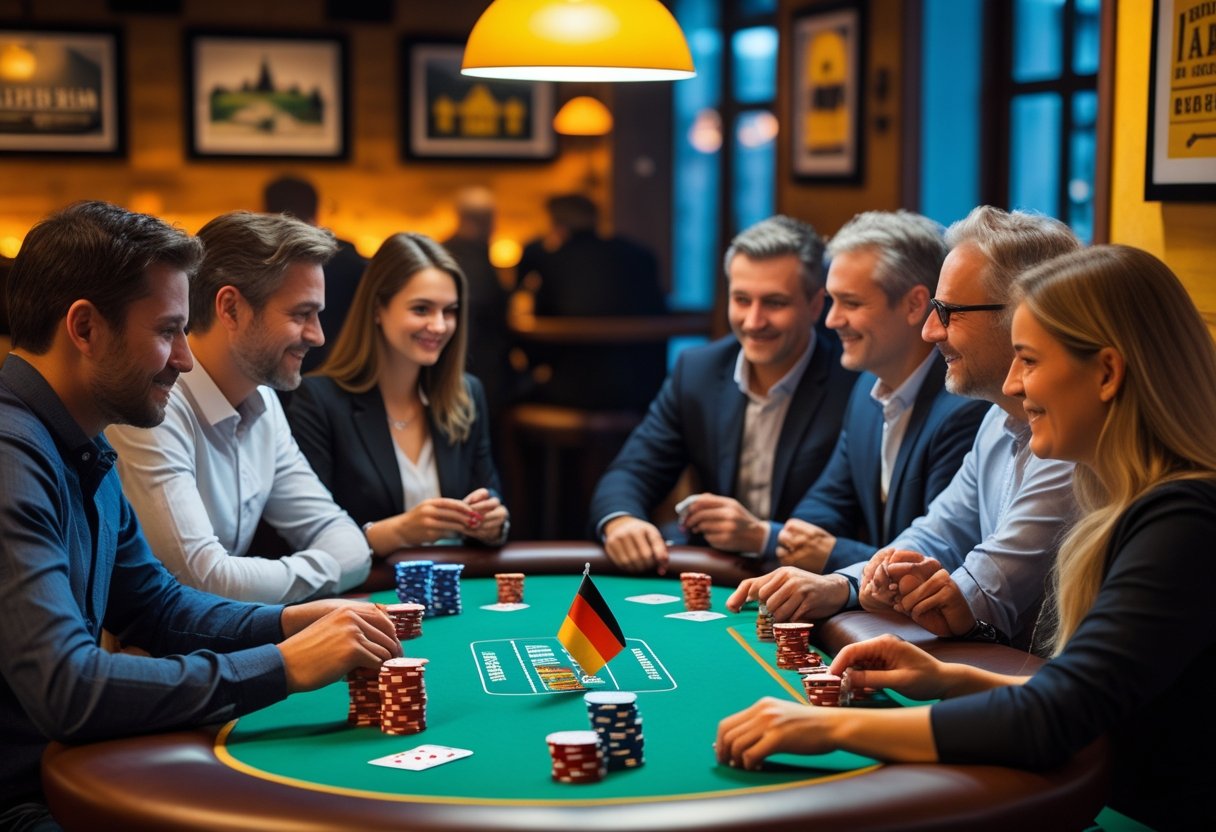
You’ll find poker opportunities throughout the country, from major casinos in cities like Berlin and Baden-Baden to online platforms that now operate with proper licenses. The poker community in Germany includes both recreational players and professional competitors who have achieved success on the world stage. Tax rules differ for casual players versus professionals who earn consistent income from poker.
This guide covers everything you need to know about playing poker in Germany. You’ll learn about the legal framework, where to find games online and in person, what tournaments are available, and how taxes work for poker winnings. Whether you’re a resident looking to play or a visitor planning a poker trip, this information will help you understand the German poker landscape.
Legal Framework for Poker in Germany
Germany regulates poker through a national treaty system that requires state permits for all operators. The Fourth Interstate Treaty on Gambling sets the foundation for both online and live poker, while individual states maintain control over land-based venues.
State Treaty on Gambling and Its Impact
The Interstate Treaty on Gambling, which took effect on July 1, 2021, established the current legal framework for poker in Germany. This treaty legalized online poker under strict government supervision and created a licensing system for operators.
The treaty introduced the Gemeinsame Glücksspielbehörde der Länder (GGL) as the central regulatory authority. The GGL oversees licensing, monitors compliance, and enforces penalties against unlicensed operators. Since January 2024, the GGL has increased enforcement efforts through stricter compliance checks and prohibition orders.
You need to understand that the treaty places significant restrictions on poker operations. All providers must obtain state permits before offering services. The licensing process includes technical requirements and compliance standards that operators must meet.
Regulations by German State
Each of Germany’s 16 federal states has authority to create its own licensing framework for land-based poker venues. State-owned casinos traditionally held exclusive rights to host poker games legally.
You can find legal poker rooms across all 16 states despite this state-controlled approach. For example, Casino Schenefeld operates in Schleswig-Holstein under state regulations. The federal structure means rules can vary between states for physical poker rooms.
Some states grant limited licenses to private operators while others maintain state monopolies. This creates a fragmented regulatory landscape for land-based poker operations.
Online Poker Legislation
Online poker became legal in Germany under the 2021 State Treaty on Gambling. You must obtain a two-part license to operate online poker in Germany: an organizer’s license and approval for individual games you offer.
The GGL requires licensed operators to meet complex legal restrictions and technical standards. All online poker sites need permits from German authorities and face rigorous monitoring. The licensing process demands specific technology implementations and ongoing compliance with advertising regulations.
Operating without a license carries serious consequences. The GGL has expanded its capacity to initiate criminal investigations and issue prohibition orders against unlicensed platforms, particularly targeting offshore operators.
Online Poker in Germany
Online poker in Germany operates under strict national regulation following the 2021 Interstate Treaty on Gambling. Players can access licensed platforms with mandatory protections and limits, or choose offshore sites that offer fewer restrictions but less legal oversight.
Licensing and Regulatory Requirements
The Interstate Treaty on Gambling (Glücksspielneuregulierungstaatsvertrag) established unified rules for online poker across all 16 German states. Operators must obtain a license through the Joint Gambling Authority (GGL) to legally offer poker services in Germany.
If you play on a licensed site, you face a €1,000 monthly deposit limit that applies across poker and slots combined. You must verify your identity and address before playing. Licensed platforms limit you to four tables at once and use random seating instead of letting you choose your table. The State Treaty on Gambling requires hourly pop-up messages during play and a panic button for 24-hour self-exclusion.
Licensed sites cannot offer casino games like blackjack or roulette alongside poker. They must maintain a common database tracking wins and losses. Rake reaches up to 6% on some platforms, higher than many international sites. You need to be at least 18 years old to play poker in Germany.
Leading Poker Platforms
GGPoker.de holds a German license and operates a separate domain for local players. You can play NLH and Omaha cash games up to $10/$20 limits, plus Rush & Cash fast poker. The platform offers WSOP Online events despite regulatory restrictions.
BetOnline Poker accepts German players through its Panama license. You get access to NLH cash games and Omaha variants with stakes up to $5/$10. The site runs tournaments with $100,000 to $200,000 Main Event guarantees monthly. BetOnline supports 19 cryptocurrencies for anonymous transactions.
CoinPoker uses blockchain technology and requires no verification. You can play NLH, PLO, and PLO5 with stakes from micro limits to $200/$400. The platform offers 33% rakeback credited every Monday. All funds stay on external wallets with hands processed through decentralized RNG.
Bonuses and Payment Methods
Licensed German sites offer modest welcome bonuses due to regulatory limits. GGPoker.de provides 100% up to €100 on your first deposit. Offshore platforms offer larger bonuses: BetOnline gives 100% up to $1,000, while CoinPoker offers 150% up to $2,000.
You can use SEPA bank transfers, Sofort (through Klarna), PayPal, Skrill, and Paysafecard on licensed platforms. These deposits process instantly except SEPA transfers, which take 1-3 business days. Minimum deposits start at €10-€20 on most sites.
Offshore sites accept cryptocurrencies for complete anonymity. Bitcoin, Ethereum, and other digital currencies process faster than traditional methods and avoid the €1,000 monthly cap. Licensed platforms only accept payment methods approved in the EU and cannot process cryptocurrency transactions.
Live Poker Venues and Casinos
Germany operates approximately 17 poker rooms across its 16 states, with most venues offering limited table options. Each state maintains its own licensing framework for land-based poker operations, creating varied experiences depending on your location.
Major Poker Venues
Spielbank Berlin stands as one of Germany’s premier poker destinations. The casino offers regular cash games and tournament action in the capital city. You’ll find professional dealers and a dedicated poker room separate from the main gaming floor.
Casino Schenefeld, located near Hamburg, provides another significant poker venue in northern Germany. The facility hosts both casual games and competitive tournaments throughout the year.
Other notable venues include Casino Baden-Baden, Casino Duisburg, and Casino Hamburg. These establishments follow strict national regulations while offering fair gaming conditions. Casino Baden-Baden attracts an international crowd due to its historic reputation and elegant setting.
You should expect professional operations at these major venues, with experienced staff and well-maintained facilities.
Poker Rooms by Region
The distribution of poker rooms across Germany remains uneven. Baden-Württemberg and North Rhine-Westphalia host multiple venues, while several states have limited or no poker facilities.
Popular locations include:
- Bad Aachen – Spiel Casino Bad Aachen (44 Monheimsallee, Kurpark)
- Bad Bentheim – Spiel Casino Bad Bentheim (Ochtruper Str. 38)
- Bad Homburg – Spielbank Bad Homburg (Im Kurpark)
- Bad Kissingen – Speilbank Bad Kissingen (Im Luitpold-Park)
- Bad Oeynhausen – Spiel Casino Bad Oeynhausen (Staatlichens Kurhaus)
Most poker rooms in smaller cities operate with just one or two tables. You’ll find the largest selections in major metropolitan areas.
Casino Requirements and Formats
German poker venues enforce strict entry requirements. You must be at least 18 years old and present valid identification upon entry. Some casinos require formal attire, though dress codes vary by location.
Most poker rooms offer Texas Hold’em as their primary game format. You’ll occasionally find Omaha and other variants at larger venues. Cash game stakes typically range from small blinds of €1/€2 to higher limit games at major casinos.
Tournament buy-ins vary widely, from €20 entry events to championship series with €500+ entries. Each venue maintains its own schedule for regular tournaments and special series events.
Poker Tournaments in Germany
German casinos host poker tournaments almost every day across the country, with No Limit Hold’em being the most common format. Buy-ins range from €5 for weeknight events to €200+ for major monthly tournaments.
Structure of Poker Events
Most German poker tournaments follow a freeze-out or rebuy structure. Freeze-out tournaments give you one entry with no rebuys, while rebuy tournaments let you buy back in during early levels. Buy-ins typically range from €30 to €150 for regular events.
Tournament structures vary by casino. Small events often have 20-minute blind levels, while larger tournaments feature 30 to 60-minute levels. You’ll find starting stacks between 10,000 and 30,000 chips. Late registration usually stays open for 2 to 4 hours.
Daily tournaments start in the evening between 7 PM and 9 PM. Weekend events often begin earlier in the afternoon. Berlin casinos run tournaments seven days a week, while smaller venues host them 2 to 3 times weekly.
Popular Tournament Series
The Spielbanken Bayern Pokermeisterschaft (SBPM) runs year-round across all Bavarian casinos. Every venue hosts weekly events with €90 to €110 buy-ins. The series culminates in an annual championship.
Berlin hosts two major series each year. The Triple A Series and German Poker Tour attract players from across Europe. These events feature multiple tournaments over several days with buy-ins from €200 to €1,000+.
The Baden-Württembergische Pokermeisterschaft takes place every November in Baden-Baden. Monthly highlight tournaments include the Herkules-Poker-Turnier in Konstanz (€220 buy-in) and the Original Freeze-out at Casino Am Fernsehturm in Berlin (€160 buy-in).
Differences Between Live and Online Tournaments
Live tournaments in Germany only happen at state-licensed casinos. You must physically attend a Spielbank to play in any prize money event. Online poker tournaments operate under different federal regulations.
The pace differs significantly between formats. Live tournaments play much slower due to physical card dealing and chip handling. You’ll see 25 to 35 hands per hour live compared to 60+ hands online.
Live events offer a social atmosphere with table talk and physical tells. Buy-ins start higher at live venues, typically €30 minimum compared to €1+ online. Live tournaments also charge entry fees separately, shown as €50+€5, where €5 goes to the casino.
Tournament Regulations
German law classifies poker as a game of chance, restricting tournaments to licensed Spielbanken. Private poker rooms and clubs cannot offer prize money events. You must be 18 years or older to enter any casino poker tournament.
Casinos collect a maximum rake or entry fee on tournament buy-ins. This fee covers staff, equipment, and venue costs. The remaining money goes into the prize pool.
Tournament directors enforce standard poker rules based on international guidelines. Most German casinos use the Tournament Directors Association (TDA) rules. Each venue posts specific house rules regarding conduct, electronic devices, and table etiquette. Registration closes during late registration periods, which the tournament structure sheet specifies before play begins.
German Poker Players and Achievements
Germany has produced some of the world’s most successful poker players, with combined tournament earnings exceeding hundreds of millions of dollars. These professionals have won major titles across the globe and helped establish Germany as a powerhouse in competitive poker.
Famous Professionals
Fedor Holz stands as one of Germany’s most recognizable poker stars. He has earned over $41 million in tournament winnings throughout his career. Holz became known for his aggressive playing style and his ability to read opponents at high-stakes tables.
Christoph Vogelsang has accumulated approximately $25 million in career earnings. He regularly competes in the world’s most expensive tournaments and has built a reputation for staying calm under pressure.
Ole Schemion from Berlin has won more than $20 million in live tournaments since 2011. He started playing professionally as a teenager and quickly became one of the most feared players at European poker tables.
Dominik Nitsche has earned over $20 million in his poker career. He started playing at age 16 and became known for his mathematical approach to the game.
Rainer Kempe rounds out Germany’s elite players with significant tournament success across multiple continents.
Notable Wins on the Global Stage
Fedor Holz won $6 million at the Super High Roller Bowl in 2017. This victory marked one of the largest single payouts for any German player at the time.
Hossein Ensan, an Iranian-German player from Münster, won the World Series of Poker Main Event in 2019. He took home $10 million from this prestigious tournament.
Christoph Vogelsang also earned $6 million at the 2017 Super High Roller Bowl. He finished in first place after days of intense competition against the world’s best players.
Leon Sturm won $1.32 million at the No Limit Hold’em Ultra High Roller event in the Bahamas in 2023. This victory helped establish him as one of Germany’s rising talents at just 24 years old.
Impact on the International Poker Scene
German poker players have changed how professionals approach tournament strategy worldwide. Their focus on mathematical probability and disciplined bankroll management has influenced players across Europe and North America.
You can find German professionals at nearly every major poker tournament series. They compete regularly at the World Series of Poker, European Poker Tour, and Triton Poker Super High Roller Series. Their consistent presence at these events has made Germany one of the most respected poker nations.
The success of players like Holz and Vogelsang has inspired a new generation of German poker enthusiasts. Young players now have role models who prove that professional poker can lead to both financial success and international recognition. This has led to increased participation in poker tournaments throughout Germany and stronger competition at local and regional events.
Taxation and Financial Considerations for Players
Germany implemented a 5.3% tax on poker stakes in 2021, and professional players may face income tax on their winnings. Your tax obligations depend on whether you play recreationally or professionally, and proper record-keeping is essential for compliance.
Tax Rules for Professional and Recreational Players
Germany distinguishes between professional and recreational poker players for tax purposes. If you play professionally, the German Federal Tax Court ruled in 2023 that your poker activities can be classified as commercial business operations subject to income tax.
The court uses specific criteria to determine if your poker play is commercial. These include your systematic approach to the game, use of analytics software, frequency of play, and whether you participate with professional intent. If you maintain multiple player accounts, play regularly, and use specialized tools to improve your performance, authorities may classify your activities as professional.
All players face a 5.3% tax on stakes for online poker. Operators collect this tax directly from your buy-ins. When you purchase a €100 tournament entry, €5 goes to taxes before you play a hand. Some platforms like GGPoker.de charge higher rake (1% more in cash games) and deduct 3% from tournament winnings to offset their tax burden.
Recreational players typically don’t owe income tax on occasional winnings. However, if tax authorities investigate your activities, they may reclassify you as professional based on your playing patterns.
Record-Keeping and Tax Compliance
You must maintain detailed records of your poker activities if authorities classify you as a professional player. Keep documentation of all buy-ins, winnings, losses, and playing sessions for at least ten years.
The Platform Tax Transparency Act of 2023 requires poker platforms to report user data and winnings to German tax authorities. This means the government likely has access to your complete playing history. If you receive a questionnaire or notice from tax investigators, you need to respond accurately and completely.
You should document the specific games you play, your player names, software tools you use, and time spent playing. These records help establish whether your activities meet the threshold for commercial operations. Many players who didn’t report poker income in previous years have faced tax evasion investigations.
If you haven’t declared past poker income, voluntary disclosure can help you avoid criminal penalties. You must report all undeclared income from the past ten years and pay the owed taxes plus interest. This option only works if authorities haven’t already discovered the offense or initiated proceedings against you.
Tax Impact on Residency Choices
Germany’s poker tax structure affects where you choose to live and play. The 5.3% stake tax applies regardless of where the operator is registered, as long as you access the platform from within Germany.
Professional players may find Germany’s tax burden higher than other EU countries. You face both the 5.3% stake tax and potential income tax on your profits if classified as commercial. This dual taxation reduces your effective return compared to jurisdictions with more favorable gambling tax policies.
Some players consider establishing residency in countries with lower gambling taxes. However, you still owe German taxes if you physically play from German territory. Your tax obligations depend on where you access the games, not just your official residence.
The regulatory landscape continues to evolve. You should consult with tax professionals who understand both German tax law and gambling regulations before making residency decisions based on poker taxation.
Frequently Asked Questions
Germany’s poker scene involves specific regulations and requirements that vary by state, with both online and live poker options available since 2021. Players need to understand licensing rules, tax obligations for professional play, and where to find legal poker venues.
What are the legal requirements for playing poker in Germany?
You must play poker at state-licensed casinos or on licensed online platforms to comply with German law. The State Treaty on Gambling regulates poker across all German states, though individual states maintain their own specific rules for live poker venues.
Private poker games are legal in Germany, but restrictions vary by state. These limitations can affect stake amounts, participant numbers, and where you can host games.
Professional poker players must declare their winnings as taxable income. You only face tax obligations if poker contributes significantly to your livelihood through consistent tournament participation and winnings.
Where can I find the best poker games in Germany?
Spielbank Berlin offers a dedicated poker floor at Potsdamer Platz and reopened in 2023 after major renovations. The casino provides regular poker games in Germany’s capital city.
Spielbank Baden-Baden has operated since 1950 and hosts regular poker tournaments. King’s Casino Rozvadov sits near the German-Czech border and focuses exclusively on poker with daily tournaments and WSOP Europe events.
You can find 32 poker rooms operating across major German cities including Berlin, Munich, Hamburg, Frankfurt, and Stuttgart. Each venue offers different game varieties and tournament schedules.
Are online poker platforms available and regulated in Germany?
Online poker became legal across Germany in July 2021 when the State Treaty on Gambling was amended. Platforms must obtain licenses from German authorities to operate legally within the country.
The Joint Gambling Authority monitors licensed operators to ensure compliance with regulations. Licensed poker sites display their credentials and follow strict guidelines for player protection and fair gaming.
You should only play on platforms that hold valid German licenses. The licensing process takes 12-18 months for operators to complete, ensuring thorough vetting by authorities.
What are the most popular poker variants played in German casinos?
Texas Hold’em remains the most widely played poker variant in German casinos and online platforms. You’ll find this game at nearly every poker venue across the country.
Tournament poker attracts significant participation, with both online and live events drawing large player pools. High-roller tournaments and regular buy-in events run throughout the year at major casinos.
German poker venues also offer Omaha and other poker variants, though these appear less frequently than Texas Hold’em. The availability of specific game types depends on the casino and player demand.
How do I locate poker rooms or casinos that offer poker near me in Germany?
You can search for poker rooms by city using online directories that list all active venues. Major cities like Berlin, Munich, Hamburg, and Frankfurt have multiple options for live poker play.
State-licensed casinos display their credentials and operating permits clearly. You should verify a venue’s licensing status before visiting to ensure legal compliance.
Online poker room finders provide current information about cash games, tournament schedules, and available stakes. These tools help you compare venues and find games that match your preferences.
Can tourists participate in poker games while visiting Germany?
Tourists can play poker at licensed German casinos without residency requirements. You need valid identification to enter casino premises and participate in games.
State-licensed casinos welcome international visitors and often provide information in English. The same rules apply to tourists and residents regarding game participation and casino entry.
You don’t face tax obligations on poker winnings unless you qualify as a professional player earning consistent income from poker. Recreational play remains tax-free for visitors and residents alike.